
Implementation of A Star Search Algorithm in python – Artificial Intelligence
In this tutorial, we will understand the A Star Search Algorithm with a solved numerical example and implementation in python.
A Star Solved Numerical Examples
A Star Search Algorithm with a solved numerical example

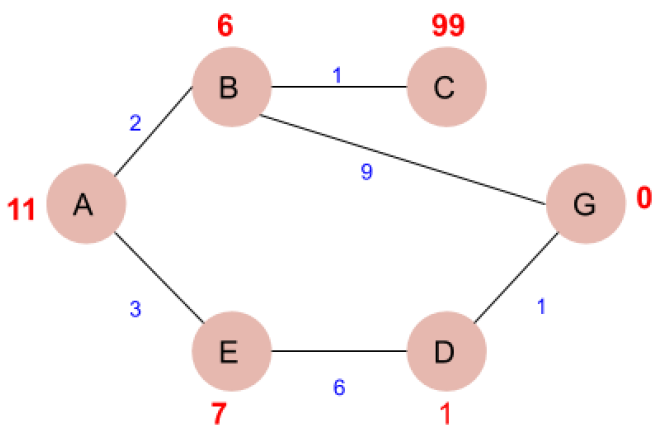
Numbers written on edges represent the distance between nodes. Numbers written on nodes represent the heuristic value.
Given the graph, find the cost-effective path from A to G. That is A is the source node and G is the goal node.
Now from A, we can go to point B or E, so we compute f(x) for each of them,
A → B = g(B) + h(B) = 2 + 6 = 8
A → E = g(E) + h(E) = 3 + 7 = 10
Since the cost for A → B is less, we move forward with this path and compute the f(x) for the children nodes of B.
Now from B, we can go to point C or G, so we compute f(x) for each of them,
A → B → C = (2 + 1) + 99= 102
A → B → G = (2 + 9 ) + 0 = 11
Here the path A → B → G has the least cost but it is still more than the cost of A → E, thus we explore this path further.
Now from E, we can go to point D, so we compute f(x),
A → E → D = (3 + 6) + 1 = 10
Comparing the cost of A → E → D with all the paths we got so far and as this cost is least of all we move forward with this path.
Now compute the f(x) for the children of D
A → E → D → G = (3 + 6 + 1) +0 = 10
Now comparing all the paths that lead us to the goal, we conclude that A → E → D → G is the most cost-effective path to get from A to G.
Implementation of A Star Search Algorithm in python
def aStarAlgo(start_node, stop_node):
    open_set = set(start_node)
    closed_set = set()
    g = {}               #store distance from starting node
    parents = {}         # parents contains an adjacency map of all nodes
    #distance of starting node from itself is zero
    g[start_node] = 0
    #start_node is root node i.e it has no parent nodes
    #so start_node is set to its own parent node
    parents[start_node] = start_node
    while len(open_set) > 0:
        n = None
        #node with lowest f() is found
        for v in open_set:
            if n == None or g[v] + heuristic(v) < g[n] + heuristic(n):
                n = v
        if n == stop_node or Graph_nodes[n] == None:
            pass
        else:
            for (m, weight) in get_neighbors(n):
                #nodes 'm' not in first and last set are added to first
                #n is set its parent
                if m not in open_set and m not in closed_set:
                    open_set.add(m)
                    parents[m] = n
                    g[m] = g[n] + weight
                #for each node m,compare its distance from start i.e g(m) to the
                #from start through n node
                else:
                    if g[m] > g[n] + weight:
                        #update g(m)
                        g[m] = g[n] + weight
                        #change parent of m to n
                        parents[m] = n
                        #if m in closed set,remove and add to open
                        if m in closed_set:
                            closed_set.remove(m)
                            open_set.add(m)
        if n == None:
            print('Path does not exist!')
            return None

        # if the current node is the stop_node
        # then we begin reconstructin the path from it to the start_node
        if n == stop_node:
            path = []
            while parents[n] != n:
                path.append(n)
                n = parents[n]
            path.append(start_node)
            path.reverse()
            print('Path found: {}'.format(path))
            return path
        # remove n from the open_list, and add it to closed_list
        # because all of his neighbors were inspected
        open_set.remove(n)
        closed_set.add(n)
    print('Path does not exist!')
    return None

#define fuction to return neighbor and its distance
#from the passed node
def get_neighbors(v):
    if v in Graph_nodes:
        return Graph_nodes[v]
    else:
        return None
#for simplicity we ll consider heuristic distances given
#and this function returns heuristic distance for all nodes
def heuristic(n):
    H_dist = {
        'A': 11,
        'B': 6,
        'C': 5,
        'D': 7,
        'E': 3,
        'F': 6,
        'G': 5,
        'H': 3,
        'I': 1,
        'J': 0
    }
    return H_dist[n]

#Describe your graph here
Graph_nodes = {
    'A': [('B', 6), ('F', 3)],
    'B': [('A', 6), ('C', 3), ('D', 2)],
    'C': [('B', 3), ('D', 1), ('E', 5)],
    'D': [('B', 2), ('C', 1), ('E', 8)],
    'E': [('C', 5), ('D', 8), ('I', 5), ('J', 5)],
    'F': [('A', 3), ('G', 1), ('H', 7)],
    'G': [('F', 1), ('I', 3)],
    'H': [('F', 7), ('I', 2)],
    'I': [('E', 5), ('G', 3), ('H', 2), ('J', 3)],
}

aStarAlgo('A', 'J')
Output:
Path found: ['A', 'F', 'G', 'I', 'J']
#for simplicity we ll consider heuristic distances given
#and this function returns heuristic distance for all nodes
def heuristic(n):
    H_dist = {
        'A': 11,
        'B': 6,
        'C': 99,
        'D': 1,
        'E': 7,
        'G': 0,
    }
    return H_dist[n]

#Describe your graph here
Graph_nodes = {
    'A': [('B', 2), ('E', 3)],
    'B': [('A', 2), ('C', 1), ('G', 9)],
    'C': [('B', 1)],
    'D': [('E', 6), ('G', 1)],
    'E': [('A', 3), ('D', 6)],
    'G': [('B', 9), ('D', 1)]
}

aStarAlgo('A', 'G')
Output:
Path found: ['A', 'E', 'D', 'G']
Summary:
In this tutorial, we understood the A Star Search Algorithm with a solved numerical example and implementation in python. If you like the tutorial share it with your friends. Like the Facebook page for regular updates and YouTube channel for video tutorials.